
Fall 2026 Market Update

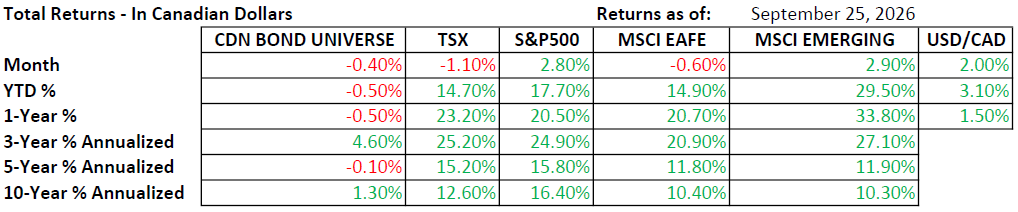
The past quarter delivered a generally constructive backdrop for investors, although economic conditions remained uneven. In Canada, real GDP rebounded by 0.8% in the second quarter, supported by stronger exports, consumer spending and business investment, while inflation stood at 3.0% and unemployment at 6.4% in August. South of the border, the U.S. economy continued to expand, with second-quarter GDP growing at a 1.5% annualized pace, supported by consumer spending and investment, while annual inflation reached 3.4% in August. Importantly, investment opportunities have continued to broaden beyond North America. Developed international equities, as measured by the MSCI World ex USA Index, gained 4.18% over the three months ending August 31 and were up 14.32% year to date, reinforcing the value of maintaining global diversification rather than relying on any single country or market to drive long-term returns.
Overall, the quarter was another useful reminder that while economic headlines can shift quickly, a disciplined and globally diversified portfolio remains well positioned to participate as leadership moves between markets.
The Statistical Case for Investing in Fixed Income
Bond yields have risen to levels not seen in over a decade, creating one of the strongest statistical entry points for fixed‑income investors in recent memory. However, many industry experts suggest not having any fixed income exposure in your investment portfolio. We would tend to argue against this, even if it’s a smaller exposure to fixed income.
Higher yields improve expected returns and provide a greater cushion against rising interest rates. For example, a 5% yield can offset approximately 0.5%–0.75% in rate increases over one year. With about 80% of global bonds now yielding more than 4%, fixed income has become more resilient—not riskier.
In the current environment, maintaining a modest underweight position in fixed income may still make sense, particularly for investors with a longer time horizon who want to retain greater exposure to the growth potential of equities.
However, being underweight does not mean avoiding bonds altogether. Today’s higher yields provide meaningful income, diversification and downside resilience, allowing fixed income to remain an important stabilizer within a balanced portfolio even at a reduced allocation.
Canada Looking Beyond the U.S.
For decades, the United States has been Canada’s most important trading partner, and that relationship will remain critical. However, recent trade tensions and a more protectionist global environment have highlighted the risks of relying too heavily on any one market. Canada is now making a more deliberate effort to broaden its economic relationships, with the federal government targeting a doubling of non-U.S. exports over the next decade. That effort includes expanding trade and investment relationships in Europe, Asia and other international markets, while also attracting more foreign investment into Canada.
We are already seeing this strategy take shape, particularly through closer economic ties with Europe. Canada has been strengthening its relationship with the European Union and looking for opportunities in areas such as energy, critical minerals, defence and technology. From an investment perspective, the broader message is important: diversification matters at the country level just as it does within a portfolio. Reducing Canada’s reliance on a single trading relationship will not happen overnight, but greater access to global markets could ultimately create new opportunities for Canadian businesses and investors.
Politics, Headlines and your Portfolio
This fall will also bring plenty of political headlines. Americans head to the polls for the midterm elections on November 3, with control of Congress at stake. Here in Alberta, voters will participate in a province-wide referendum on October 19, including a non-binding question asking whether Alberta should remain a province of Canada or whether the government should begin the legal process required to hold a future binding referendum on separation. With consequential issues being debated on both sides of the border, it would not be surprising to see political uncertainty dominate the news cycle at times this fall.
For investors, however, it is important to separate political importance from investment importance. Elections and referendums can influence individual industries, regulations and investor sentiment, but markets ultimately have many more forces to digest, including corporate earnings, economic growth, inflation and interest rates. In our view, much of the political discussion this fall is likely to be noise rather than a reason to make significant portfolio changes. That does not mean politics should be ignored, but it does mean investment decisions should remain grounded in long-term fundamentals rather than predictions about election outcomes. A diversified portfolio is specifically designed so that your financial success does not depend on one politician, one election, or one political outcome.
Lifeboat Drill: Staying Calm When Markets Get Rough
Recent market performance over the past three years has been exceptionally strong, which can make it easy to become accustomed to favorable returns and underestimate the possibility of future declines. This period of strong performance makes the Lifeboat Drill especially important. By discussing expectations and responsibilities now—while markets have been rewarding—we can prepare for the inevitable periods when returns are less favorable and help ensure that future decisions remain grounded in your financial plan, personal objectives and long-term priorities rather than shaped by disappointment, fear or market noise.
As your advisor, we affirm that we will:
- Provide education and historical context to help prepare you for both market gains and losses.
- Remind you that market corrections are normal, including during years that ultimately produce strong returns.
- Caution against chasing inflated assets or investments simply because they are popular.
- Act as a sounding board when markets become difficult, helping evaluate decisions rationally rather than emotionally.
- Build a durable portfolio diversified across asset classes, sectors, geographies and currencies.
- Apply discipline and regularly review your portfolio to ensure it remains aligned with your priorities and goals.
- Encourage sound financial habits and realistic expectations throughout the market cycle, rather than focusing excessively on short-term underperformance.
The commitment works both ways. A successful long-term investment relationship also requires clients to recognize that uncertainty and declines are part of investing and to communicate when market conditions are creating concern. The goal is not to ignore volatility, but to make sure the response to it remains consistent with the plan that was established when conditions were calmer.
As our client, you affirm that you will:
- Reaffirm your commitment to your financial plan annually and avoid allowing emotions to undermine long-term decisions.
- Accept that volatility and market declines are an inevitable part of investing and that short-term uncertainty should not change a long-term plan.
- Maintain realistic expectations and remain skeptical of market bubbles and exaggerated claims.
- Communicate your concerns or anxiety about markets with us rather than acting on them alone.
- Take confidence from a portfolio constructed around your personal objectives and risk tolerance.
- Avoid making investment decisions based solely on market noise, the latest hot trend or investment tips from friends and family.
- Resist becoming overly focused on short-term account values, which can encourage unnecessary action and potentially hurt long-term results.
Ultimately, the Lifeboat Drill is about agreeing on our response before the rough waters arrive. Markets will periodically test investor confidence. When that happens, our responsibility is to provide perspective, discipline and advice, while your commitment is to communicate with us and remain anchored to the long-term plan. That shared discipline is an important part of helping keep temporary market volatility from becoming a permanent financial mistake.